Overview
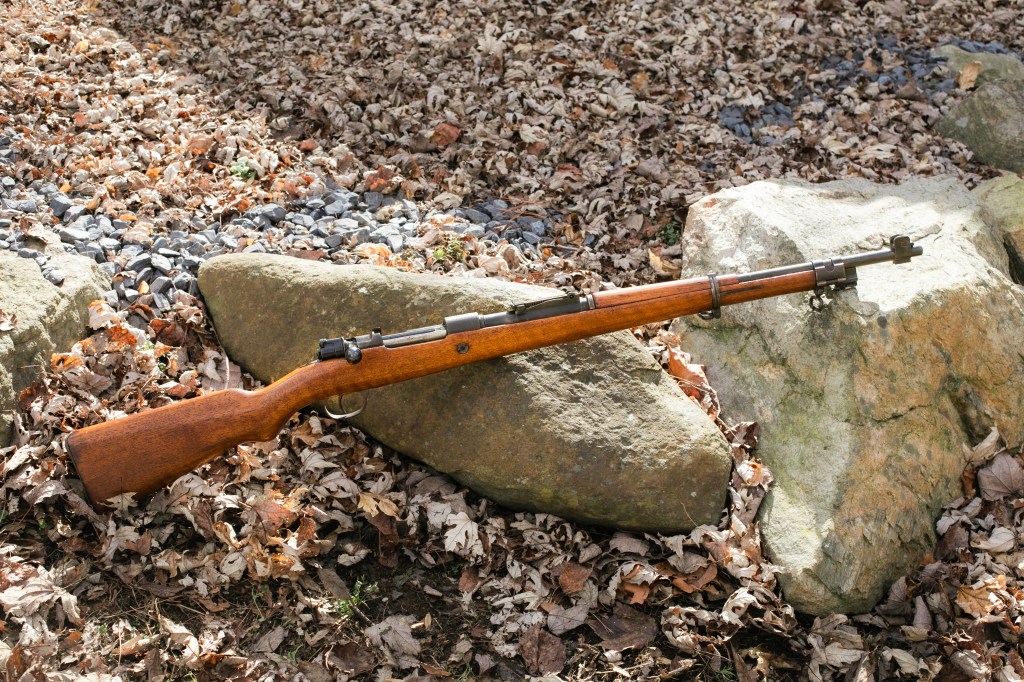
The Belgian Model 1935 Short Rifle (Fusil Modèle 1935) represents Belgium’s final pre–Second World War attempt to standardize its infantry rifle inventory around a modernized Mauser-pattern service rifle. Developed during the interwar period, the Model 1935 reflects a military balancing modernization with limited time, industrial capacity, and looming geopolitical realities.
Belgium had long used the 7.65×53mm Mauser cartridge, and the Model 1935 continued that tradition in a compact “short rifle” format that combined the reliability of the Mauser 98 system with updated military ergonomics.
Production occurred only briefly before the German invasion of May 1940, meaning relatively few were produced compared to earlier Belgian Mauser rifles. Some rifles were newly manufactured, while others were rebuilt from earlier Mauser-pattern receivers as part of Belgium’s modernization effort.
Receiver crest and royal cypher
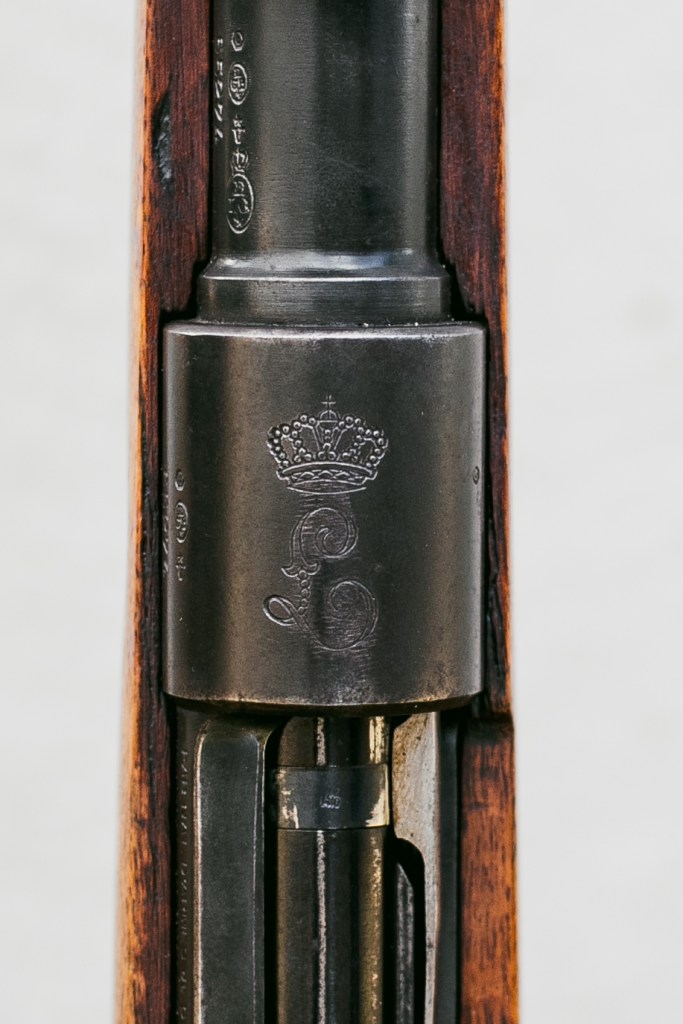
One of the defining features of this rifle is the crowned “L” royal cypher on the receiver ring, representing King Leopold III, who reigned from 1934 to 1951. This crest firmly places the rifle within the late-interwar Belgian military production period.
The machining and finish of the receiver reflect the high-quality industrial standards associated with Belgian arms manufacture during this era.
Proof marks and serial numbers
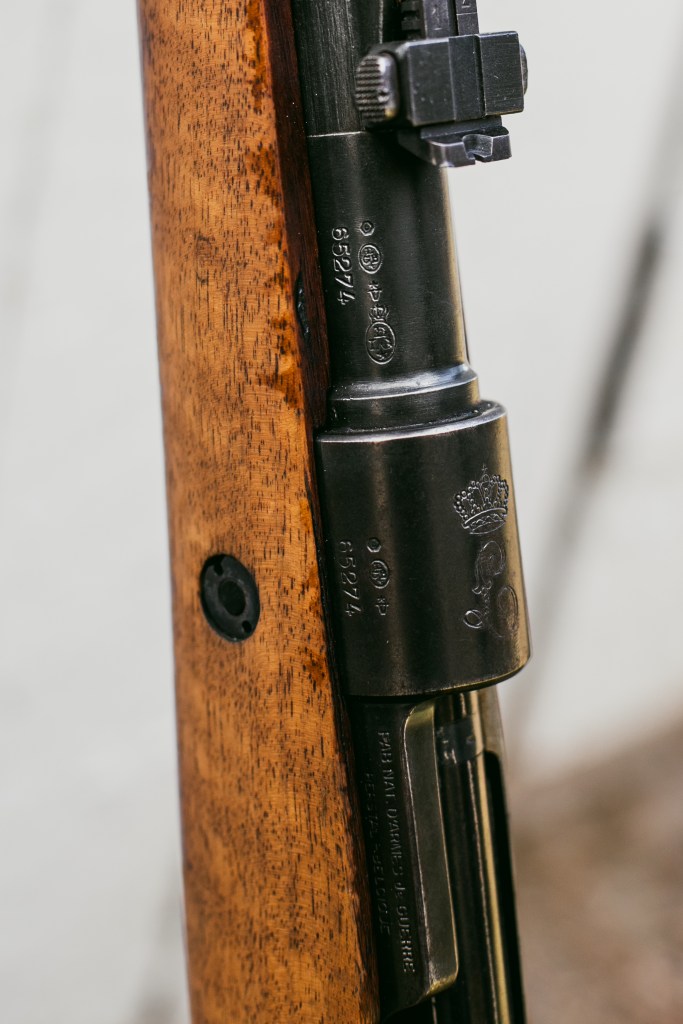
The rifle shows a clear cluster of Belgian Liège proof marks, part of the long-standing national firearms proofing system centered in Liège. These marks confirm inspection and acceptance through Belgium’s official proof-house tradition.
The serial number 65274 appears clearly on the receiver and barrel area, and matching numbers on visible components suggest the rifle remains intact rather than assembled from mixed surplus parts — an important collector detail.
The photos also clearly show the left-side receiver marking:
“FAB. NAT. D’ARMES de GUERRE – HERSTAL-BELGIQUE”
This identifies production by FN Herstal, Belgium’s premier arms manufacturer and one of the most important Mauser producers of the twentieth century.
Sights and configuration

The rifle retains a classic Mauser tangent rear sight, graduated from 200 to 1900 meters, consistent with European military doctrine of the early twentieth century.
Typical Model 1935 specifications include:
- Mauser 98–pattern bolt action
- Chambered in 7.65×53mm Mauser
- Five-round internal magazine
- Tangent rear sight
- Approx. 600 mm barrel
- Approx. 1.1 m overall length
The bolt, receiver geometry, and sight configuration all reflect the evolutionary refinement of the Mauser system rather than a completely new design.
Service context
The Model 1935 entered Belgian military service only shortly before World War II. Units such as the Chasseurs Ardennais and mobile frontier formations were among those equipped with the rifle during Belgium’s final prewar modernization effort.
Following the German invasion in 1940, many Belgian rifles were captured and reissued by German forces. After the war, surviving rifles sometimes underwent refurbishment or conversion programs, contributing to the variety of configurations encountered today.
Because production was interrupted by war, the Model 1935 remains a relatively uncommon Belgian Mauser, especially compared to earlier FN-produced export and military rifles.
Collector’s reflection
The Belgian Model 1935 Short Rifle occupies a unique place in Mauser history — not as a long-serving global standard, but as a snapshot of a nation preparing for war under severe time pressure.
With its Leopold-era crest, FN Herstal manufacture, Liège proof marks, and matching serial numbers, this rifle is a tangible artifact of Belgium’s final interwar rifle program.
It is both a military tool and a historical document from the closing years of the Mauser bolt-action service rifle era.
 Contract Mauser
Leave a comment